Water Damaged iPhone in Sydney: 'It Still Works' Isn't Enough
Your water damaged iPhone still switches on, but corrosion can keep spreading. See how a Sydney buyer grades liquid damage and what it means for your sale.
Your water damaged iPhone still turns on. You take that as a win. But in the Sydney resale market, “it still works” is not the same as “it’s fine.”
The problem is that liquid damage is a different beast from a cracked screen. A cracked screen is a finished fault: you can see it, price it, and move on. Water damage is an open-ended fault. It may keep causing doubt for a buyer, because there are parts you cannot see and problems that do not always show up straight away.
In this post, we’ll walk through why a working iPhone is not a clean bill of health, why a cracked screen is a finished fault while water damage is an open one, whether a water damaged iPhone can be fixed, what a water damaged screen is really telling you, the hidden parts after drying, how a Sydney buyer grades liquid damage, and whether to repair first or sell as is. We’ll also cover what to do today, quick answers, and why deciding now beats letting it sit in a drawer.
If you want to move forward, you can request a quote at https://sellphones.sydney/inquiry.
Why a Working iPhone Is Not a Clean Bill of Health
Most people only look up "water damaged iPhone" after the phone has dried out and switched on again. That is exactly when the damage stops being visible and starts being easy to ignore.
There is a gap worth knowing about. Recent iPhones are advertised with water resistance ratings, yet standard warranty terms exclude damage caused by liquid contact. An overseas class action complaint has challenged that tension, though it remains an allegation, not Australian law.
A phone that powers on is one data point, not a diagnosis. It tells you the battery and logic board responded at that moment. Areas commonly reported as vulnerable, and not covered by that moment of working, include the charging port pins, the sensor array behind Face ID, and the seals that keep moisture out.
Two questions matter: is there a visible symptom, and is there any real chance liquid got inside? If the second answer is yes, the phone carries an open-ended fault whether or not it behaves.
Further on, we separate water damage from a cracked screen, weigh whether repairing pays off, look at how a Sydney buyer grades liquid exposure, and show how to decide today instead of leaving the phone in a drawer.
A Cracked Screen Is a Finished Fault. Water Damage Is an Open One.
A cracked screen is a clean, closed problem. Water damage is the opposite: an unfinished one.
A cracked screen is a finished fault: you can see it, photograph it, describe it, and a buyer can price one known part replacement. The fault stops there.
Liquid contact is unknown, uncapped and invisible. There may be no residue to photograph and no mark to show anyone, so neither of you can prove what is happening inside.
That changes the money, not just the mood. A visible fault is priced as a repair. An invisible one is priced as a risk, because the buyer takes on outcomes neither of you can predict. Which is why a chipped phone with no liquid history can be easier to sell, and priced more kindly, than a flawless phone that went for a swim.
Water damage is graded as a category, not a scratch. Hiding it doesn't remove the fault, it just moves the surprise to the buyer. And if you're clearing a drawer of old handsets, one pickup for the lot is worth knowing about.
Next, whether any of this can actually be fixed.
Can a Water Damaged iPhone Be Fixed?
Sometimes, yes, but not quite in the way you might hope. A repair fixes the symptom a technician can find, not every symptom your water damaged iPhone might develop later.
What repair realistically covers: cleaning and drying can clear muffled speakers, sticky buttons or a fogged camera. Replacing a part fixes that part and nothing else. Liquid damage rarely shows up as one clean fault, so a technician may need to open the phone before knowing what has been affected. You could be paying for time and parts with no certainty about the outcome.
Liquid contact is commonly excluded under standard warranty terms, so a repair is usually something you fund yourself. Costs vary by model and by what is found, so get a quote before committing.
The seller's takeaway is blunt: a completed repair does not erase the liquid history. The phone still gets graded as one that has been wet, which is why plenty of people choose to sell it as-is to a local buyer rather than fund a fix that only resets the clock.
Water Damaged iPhone Screen: What You Are Actually Looking At
The display is often where it shows up first. If your screen is playing up after a spill, you are probably seeing one of a few things: patchy backlight, faint vertical or horizontal lines, dark blotches under the glass, ghost touch, or dead zones along an edge.
Here's the difference that matters. A crack is a break you can point at. Liquid can sit between the layers of the display assembly, causing symptoms that come and go. That is far harder to show a buyer.
And the timing trap is real. A screen that looks perfect today can develop discolouration or touch problems later, so a working display does not close the question of whether liquid got in.
A replacement screen also proves less than people assume. It resolves the display fault. It does not rule out charging port, battery or board issues on the same phone, so a screen repair alone does not make the device clean.
If you can, photograph the screen while it is misbehaving. A photo of the fault gives a local buyer who comes to you something concrete to assess, rather than a description of a symptom that has since vanished.
The Part You Cannot See After the Phone Dries
A towel, a hairdryer or a bag of rice only treats the outside of an iPhone. Moisture already inside sits where those methods cannot reach, and it does not always announce itself on day one. Damage can develop after a phone looks dry, so a good week is not evidence that nothing is happening. Areas commonly reported as vulnerable include the charging contacts, the sensor array behind Face ID, display connectors and speaker components. Those are places where moisture and residue tend to cause trouble, not a checklist of what has definitely gone wrong.
At the point of sale, this changes the maths. A buyer is not pricing what your phone does today; they are pricing the chance of what it does next month. That is what an open-ended fault means.
If you know the phone was exposed, you already have the information you need. Waiting for a symptom only delays the sale and can add a second fault to the description. If you're planning ahead, erasing your iPhone properly is worth doing before you list it.
How a Sydney Buyer Grades Liquid Damage
So how does a buyer actually use that information? At SellPhones Sydney, we grade liquid exposure as a fault category, not a cosmetic mark. Flawless glass matters less than the phone's history. Three things get weighed: what the phone does now, what you know about the exposure, and whether your description matches the symptoms. Those three answers set a price band: the phone lands in the fault category its history and symptoms justify, with room built in for whatever has not surfaced yet.
That is why disclosure beats a vague listing. Say the phone was wet and you are assessed on facts. Say nothing and you are assessed on assumption, which is usually harsher. The same logic applies whether you are handing it over in person or posting it, since both routes price the same fault.
Describe the phone and the liquid exposure in your quote request, and the Sydney buyer can assess the device on what is actually known.
Repair It First, or Sell It As Is?
Now that you know how a local buyer grades liquid damage, the choice comes down to which uncertainty you want to carry. A repair buys you one working part and a bill. An as-is sale hands the uncertainty to a buyer who deals with wet phones all the time.
Repair costs vary by model and by what a technician finds, and that spend is rarely recovered in the sale price of a phone that already carries a liquid history.
A repair can suit you if you're keeping the phone, if there's one clearly visible fault you can get quoted upfront, or if the rest of the device is in strong condition and would be simpler to sell working.
An as-is sale suits you if you're upgrading now, if you don't want to fund a repair with no guaranteed outcome, or if the phone has been sitting in a drawer getting older and less relevant.
For most Sydney sellers, the honest as-is sale wins. Paying for a repair tends to reset the clock rather than close the fault. Our practical selling guides cover the prep steps if you decide to sell.
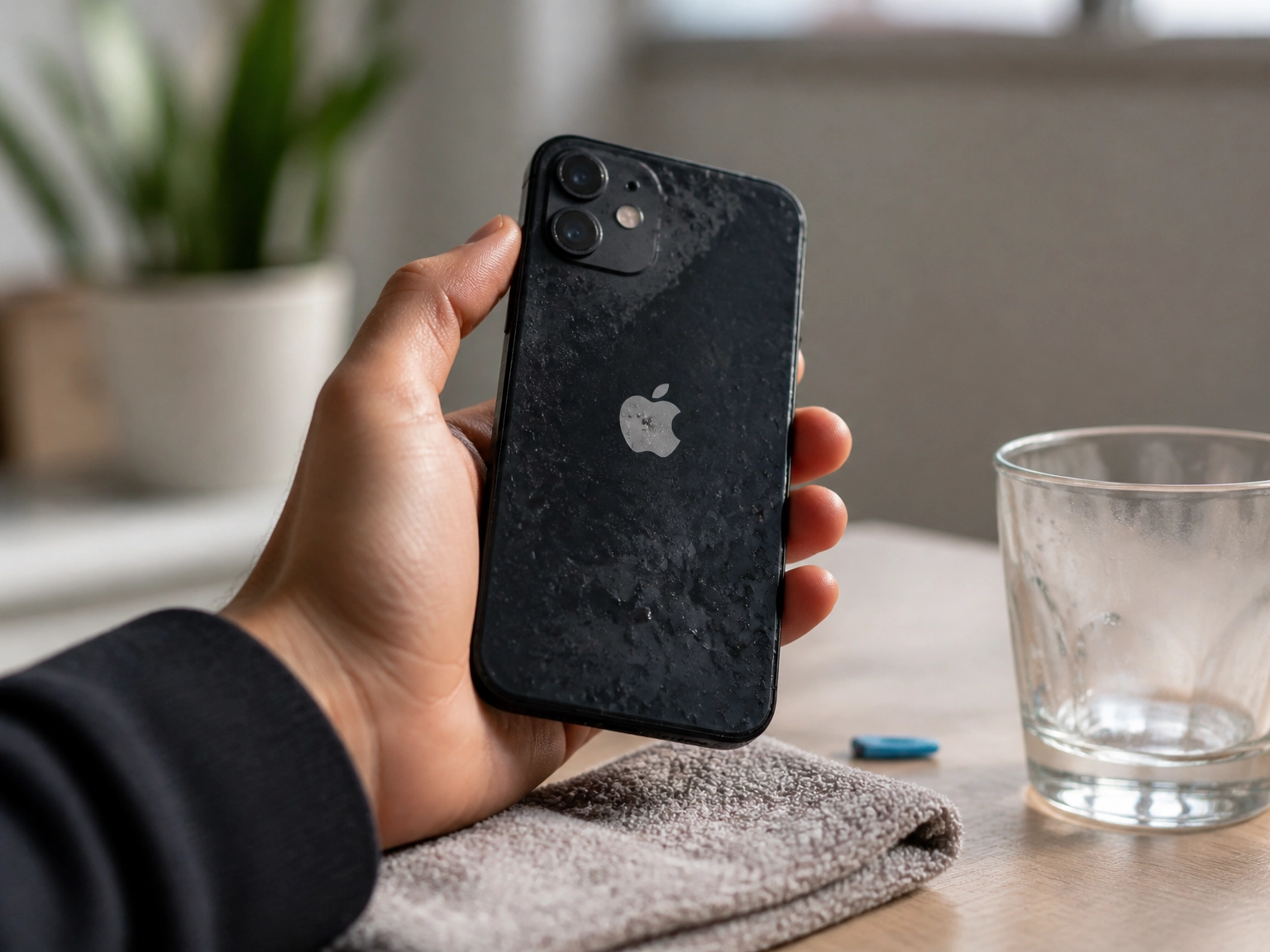
Selling a Water Damaged iPhone in Sydney: What to Do Today
If you have decided the as-is sale is the better path, the next step is simple: hand over facts, not hope. Say up front that the iPhone has had liquid exposure. It is part of how a Sydney buyer assesses the device, and it saves you explaining a surprise later.
Before pickup, treat it like any other sale. Back up your data, sign out of your Apple ID and turn off Activation Lock, then remove your SIM or transfer your eSIM. Gather the model, the symptoms you have noticed, when the liquid exposure happened, and any repair you have already paid for.
Skip the folklore too. Do not charge a wet phone in a rush, and do not treat a bag of rice as a repair. Rice might handle surface moisture, but it cannot reach the inside of the phone.
Timing matters as well. How release timing shifts offers is worth knowing before you list.
When you are ready, request a quote and describe the phone and its liquid history in the enquiry, so the assessment is based on facts rather than guesswork.
Quick Answers on Water Damaged iPhones
Here are the short answers to the questions that come up most.
Can a water damaged iPhone be fixed? Sometimes. A repair can resolve the fault a technician identifies, but it does not guarantee no further fault will develop. That is why water damage stays an open-ended category.
How do you fix a water damaged iPhone? Keep it switched off, do not charge it while wet, let it dry properly, then have it assessed. If a fault appears, that part can be repaired or replaced.
Will the screen need replacing? Not always. Blotches, lines, or dead touch zones usually mean a display replacement is where diagnosis begins.
Is a water damaged iPhone worth selling? Often yes. A buyer who deals in damaged phones can absorb the uncertainty, which makes an as-is sale practical for a seller upgrading now.
Does water damage affect value? Yes. It moves the phone from a condition question to a fault category, and that category is graded with room for what has not happened yet.
Decide Today, Not After Another Three Months in a Drawer
Those short answers all point the same way: if your iPhone has been in liquid, it is a water damaged iPhone, whether or not it powers on today. Naming it that way gets you a clearer answer faster than hoping it stays quiet.
The prep is the same as any sale, just with the liquid history told straight.
Then choose with your eyes open. A repair fixes what a technician can find, while an as-is sale hands the uncertainty to a buyer who prices for it.
What you should not do is wait for a fault to appear. A drawer does not make a phone less water damaged. It only ages the model and delays the decision, while a clear description today gets you a quote today.
So choose today. A clear description now gets the phone assessed on what is known.
Conclusion
A water damaged iPhone stays water damaged even when it powers on.
That clear description is what speeds up a real quote. Do not let another three months in a drawer age the model and delay your decision. Then let a local buyer assess the phone on what is known, not on what you hope will not happen.